The Most Pressing Questions About Invisible Braces
The existence of invisible braces has already become widely known to the vast majority of people. In the Czech Republic, more and more patients are choosing this method because they want to straighten their teeth discreetly, without the need for wires or metal. Yet this method is still relatively new, and there are many questions surrounding it. In this article, we’ll try to answer the ones you might have been afraid to ask.
Life with Braces
How will my life change with invisible braces? That’s a question many of you are probably asking yourselves. The truth is, it takes some time to get used to wearing braces and to establish a routine that works for you. When we asked our clients this question, the most common answer was: “I brush my teeth much more often now, and I don’t snack as much throughout the day.”
That makes sense. Before every meal, you need to remove your braces and put them away in a case. That’s why many patients think twice about whether it’s worth snacking on nuts and chocolate every time they visit the kitchen. The same goes for sugary sodas—you shouldn’t drink those while wearing braces either. There’s a risk that sugar will “settle” behind the braces, creating an environment conducive to tooth decay. But if you don’t want to give up sweet drinks, here’s a little tip for you: use a straw 😊
Dental care will become a bigger part of your life. It’s a good idea to get a travel toothbrush set that you can take with you wherever you go. We also recommend using interdental brushes or dental floss. Trust us—proper dental care will save you a lot of worry and the hassle of having to fix cavities in the future.
What about talking with invisible braces?
Although invisible braces are comfortable and you’ll get used to them very quickly, they’re still a foreign object in your mouth that you need to adjust to. However, most patients get used to their braces within the first week of wearing them and learn to speak without any problems. You just need to be prepared for this and not be alarmed during those first few minutes of wearing them. Give yourself time to get used to them and practice for a while. We can tell you that even our recruiter at Svět rovnátek wears braces and routinely wears them to all her interviews. And she handles it brilliantly!
Regular checkups for braces?
Thanks to Virtual Care, you can now handle these from the comfort of your own home. You only need to come to the clinic in a few cases, such as when attachments need to be re-cemented or in the event of more serious complications. Otherwise, all you need to do is take a photo of your teeth each week and send it via the app. We’ve written more about virtual checkups in this article, so be sure to check it out.
Arrange a free consultation
We will scan your teeth, suggest a treatment and price.

How does it all work?
Don’t worry—we won’t go into the complex technology behind the production and planning of braces here. Still, let us give you a brief introduction to clear aligners.
Teeth straightening is done using plastic aligners. The number of aligner sets varies depending on the complexity of the case; there may be as few as 20 or as many as 80. The aligners are always worn for 22 hours a day for 7–10 days, as directed by your dentist. After that, you switch to the next set.
The aligners are made of biocompatible plastic that is soft and comfortable. Each aligner is designed to move the teeth into the desired position by millimeters, sometimes even hundredths of a millimeter. This makes the treatment less painful, as there is no sudden tightening, unlike with fixed braces, for example. The teeth move slowly and gradually.
Treatment Plan
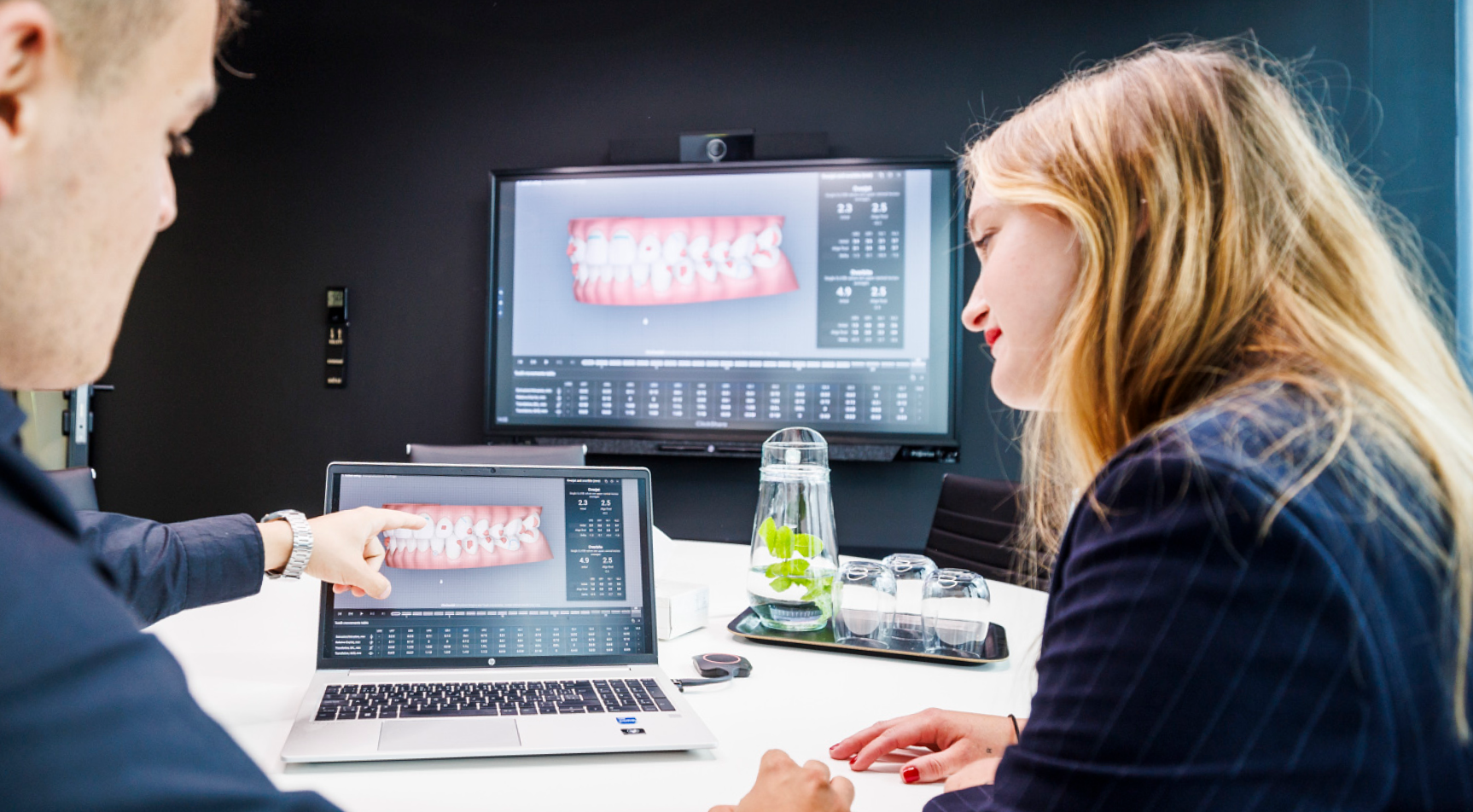
The entire treatment is planned in advance based on a 3D scan, X-rays, and other diagnostic data. Our 3D technicians develop the treatment plan, mapping out every movement in the software with precision down to a hundredth of a millimeter. This allows us to know exactly how and where the teeth need to be moved and what their final position should look like. However, biology also plays a role here. Every patient is different, and every set of teeth responds to treatment differently. This must be taken into account, and if the treatment does not progress as expected, we must adapt accordingly.
But how can such a small piece of plastic move your teeth?
Attachments and rubber bands
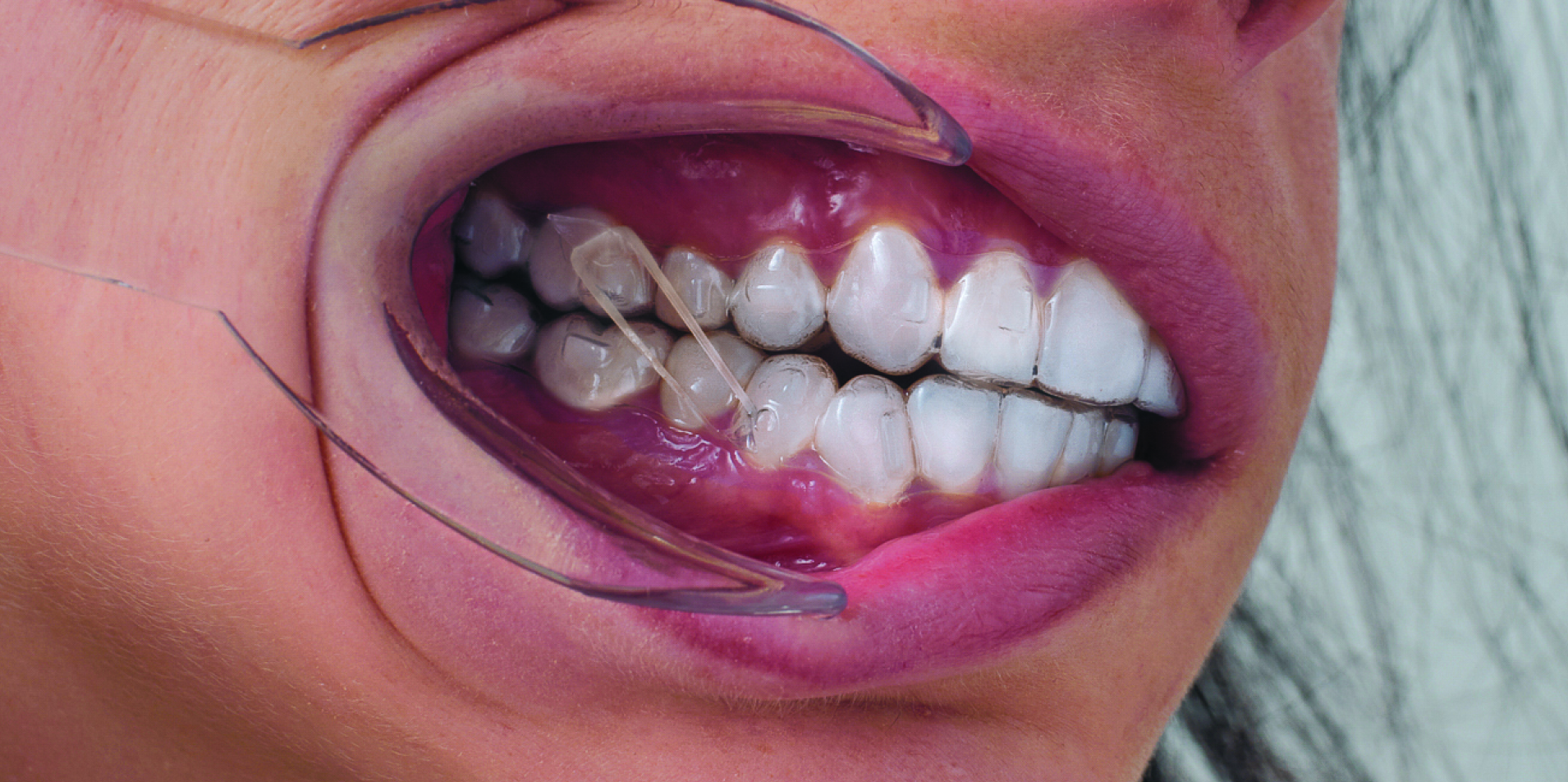
Attachments are small, tooth-colored composite pieces that are bonded to the enamel. Thanks to these attachments, teeth can be moved quickly and effectively in the desired direction. It is precisely because of them that even a wide range of complex cases can be treated using invisible braces.
During treatment, it is common for us to remove or reattach certain attachments—to ensure the treatment proceeds as quickly as possible. If an attachment happens to come loose, we can easily reattach it at the clinic. Just give us a call, and we’ll discuss the next steps.
Once treatment is complete, the attachments are removed, leaving no trace behind! They do not damage the enamel in any way, nor do they cause discoloration.
Even during treatment with clear aligners (Invisalign), it may be necessary to use elasticbands. In such cases, small buttons are bonded to certain teeth, and the elastic bands are hooked between the upper and lower jaws.
This preserves the aesthetic appeal of the treatment while effectively addressing bite issues.
It's up to you! Or: Treatment Duration and Cooperation
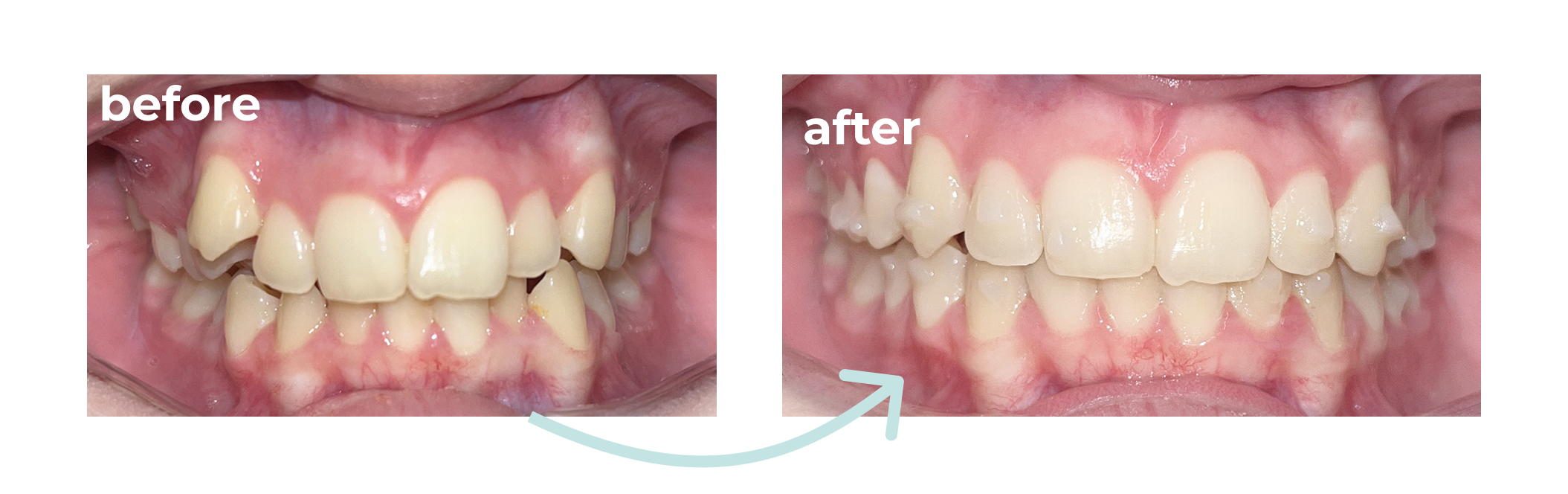
At Svět rovnátek, we do everything we can to ensure that treatment is as effective and as short as possible. We’ve had countless cases where treatment lasted just 6 months and the results were amazing! You can check out some “before and after” photos on our Instagram, for example .
The initial condition and genetics play a major role. Some teeth are reluctant to move, while others move exactly as planned. We probably won’t make you happy, but the truth is that everything is highly individual, and nothing can be predicted with certainty in advance.
Cooperation is essential!
In addition to genetics and a properly designed treatment plan, patient compliance is extremely important. Braces must be worn 22 hours a day and, ideally, removed only for eating or brushing your teeth. It is also essential to follow the treatment plan and change the aligners as instructed. Regular check-ups are also crucial, as they allow us to monitor your progress each week and detect any issues early on.
Your diligence and commitment will determine how quickly you complete your treatment. That’s why we urge you to wear your braces!
Retention
After successful treatment comes the retention phase. This phase begins regardless of whether you underwent treatment with traditional fixed braces, lingual braces, or clear aligners.
Please don’t underestimate this stage! It’s an essential part of the process that keeps your teeth in the desired position. Biology is relentless, and it’s natural for teeth to shift slightly throughout your life. That’s why, if you want to maintain a perfectly straight smile, it’s essential to wear retainers.
Retainers are made of a sturdier plastic and are designed to keep your teeth from shifting. You usually start by wearing them intensively, just like with clear aligners, for 22 hours a day. This time gradually decreases, and most patients wear them only at night. They must be worn for at least as long as the treatment lasted—so if you wore braces for a year, you must wear the retainers for at least a year as well. Ideally, you should wear them at night for the rest of your life.
Finally, we’d like to remind you that the retention phase is essential for all types of orthodontic treatment. So you definitely won’t be able to avoid it, whether you have traditional braces or clear aligners.
Do you have any other questions about invisible braces? Be sure to check out our blog—we’ve got plenty of interesting articles for you! You’ll also find many answers in our Q&A section.
Alternatively, please contact us at +420 220 910 920 or info@svetrovnatek.cz. We’d be happy to answer any questions you may have.